

Gamification & Business
Points, badges and leaderboards only work when they are wired to something the business actually cares about. How to design gamification that survives contact with real users.

The short version
- Gamification means adding game mechanics to non-game environments to lift participation. It works, but only when the design and the execution are right.
- The published results are substantial: Deloitte’s gamified training halved completion time; HP’s reseller programme lifted sales 56.4%.
- Every effective implementation is data-driven. If you cannot measure the behaviour you are trying to change, you cannot gamify it.
- The most common failure is bolting on points and badges that are not wired to anything the business actually cares about.
Everyone wants an application where users are actively engaging with the platform, or where employees stay motivated and driven towards business goals. Businesses have long looked at gamification for SaaS products, for e-learning, and internally to lift morale.
Done well, gamification increases user interaction and employee performance, and frees management to focus on growing the business rather than chasing compliance. Done badly, it produces a leaderboard nobody looks at. This article covers what separates the two.
What gamification actually is
Gamification is adding game mechanics to non-game environments — a website, an online community, a learning management system, a company intranet — in order to increase participation.
Games include mechanics such as points, challenges, leaderboards, rules and incentives that make play enjoyable. Gamification applies those mechanics to motivate an audience towards higher and more meaningful levels of engagement. The aim is to get consumers, employees and partners to collaborate, share and interact.
Does it actually work?
The first question a business asks is whether it needs gamification at all, whether the target audience will use it, and whether it delivers results. The answer to all three is yes — conditional entirely on design and execution.
Some documented outcomes:
- Google’s travel expense system reached close to 100% employee compliance.
- Spotify introduced a mobile game for its annual reviews; over 90% of its workforce participated voluntarily.
- Deloitte’s gamified training programmes take 50% less time to complete, and improved long-term engagement.
- Hewlett Packard’s Project Everest, which awarded holiday packages to top reseller teams, improved sales by 56.4%.
- Uber uses a range of gamification mechanics to keep more drivers on the road.
- Nike used gamified feedback to drive more than five million customers past their personal fitness goals daily.
Source: Finances Online — gamification statistics.
Read those numbers carefully. Every one of them comes from a programme where the mechanic was attached to a behaviour the organisation was already measuring and already cared about. None of them come from adding a points counter to an existing dashboard and hoping.
Data and gamification
True gamification is entirely data-driven, and lets a business monitor audience performance in real time. It works best when you understand it in your own context: analyse the metrics that matter to you, then build something your specific audience will actually want to use. You are not building a game for a general audience; you are adding value to a business.
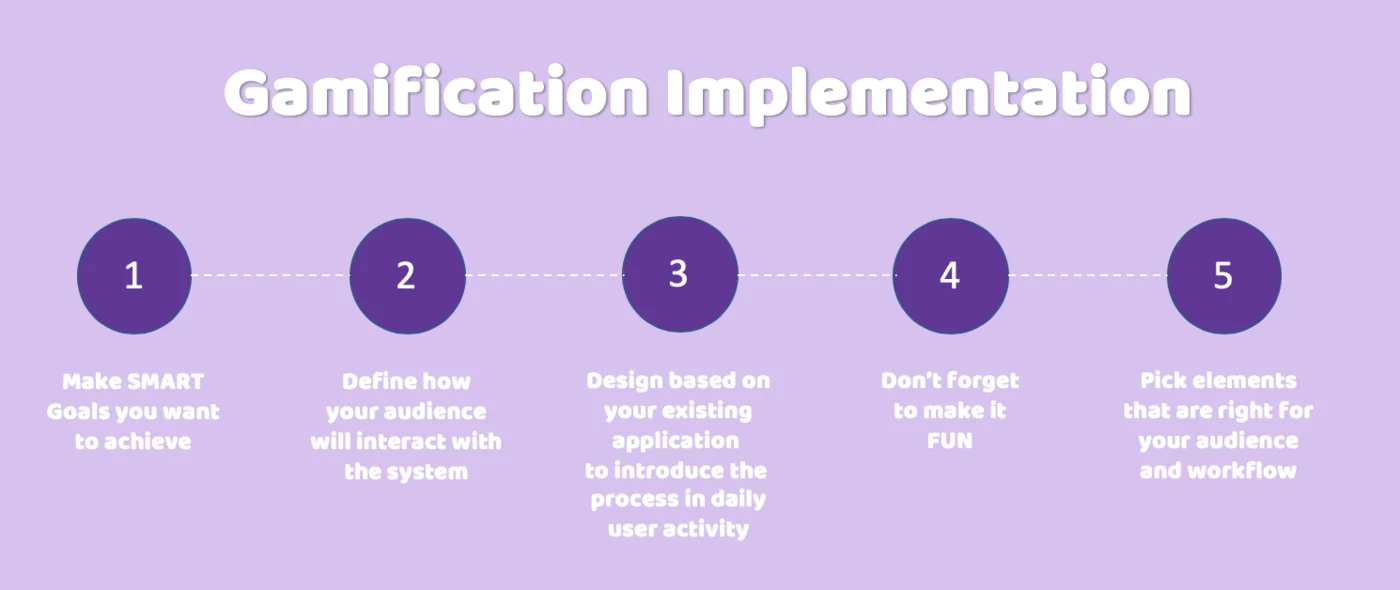
Key considerations before you build
- Define your goals. Know what you want to achieve and why, then work backwards to the steps required. SMART objectives are a reliable way to sharpen this.
- Understand user outcomes. What should the audience achieve by using this? What actions earn rewards? Are those actions connected, sensibly, to the business objectives?
- Design around the experience. Where does this sit in the existing workflow? Can it integrate with the other tools people already use? What makes it likely to still be used in three months?
- Make sure it is fun. Otherwise it is not gamifying anything. Involve the audience from the start — a small group presenting ideas, beta testing, and becoming advocates once it launches.
- Pick mechanics that suit the audience. Leaderboards and rewards are essential in competitive environments, and pointless in collaborative ones. Incentives can be coupons, packages, free subscriptions or extended plans. Choose what will appeal to your audience specifically.
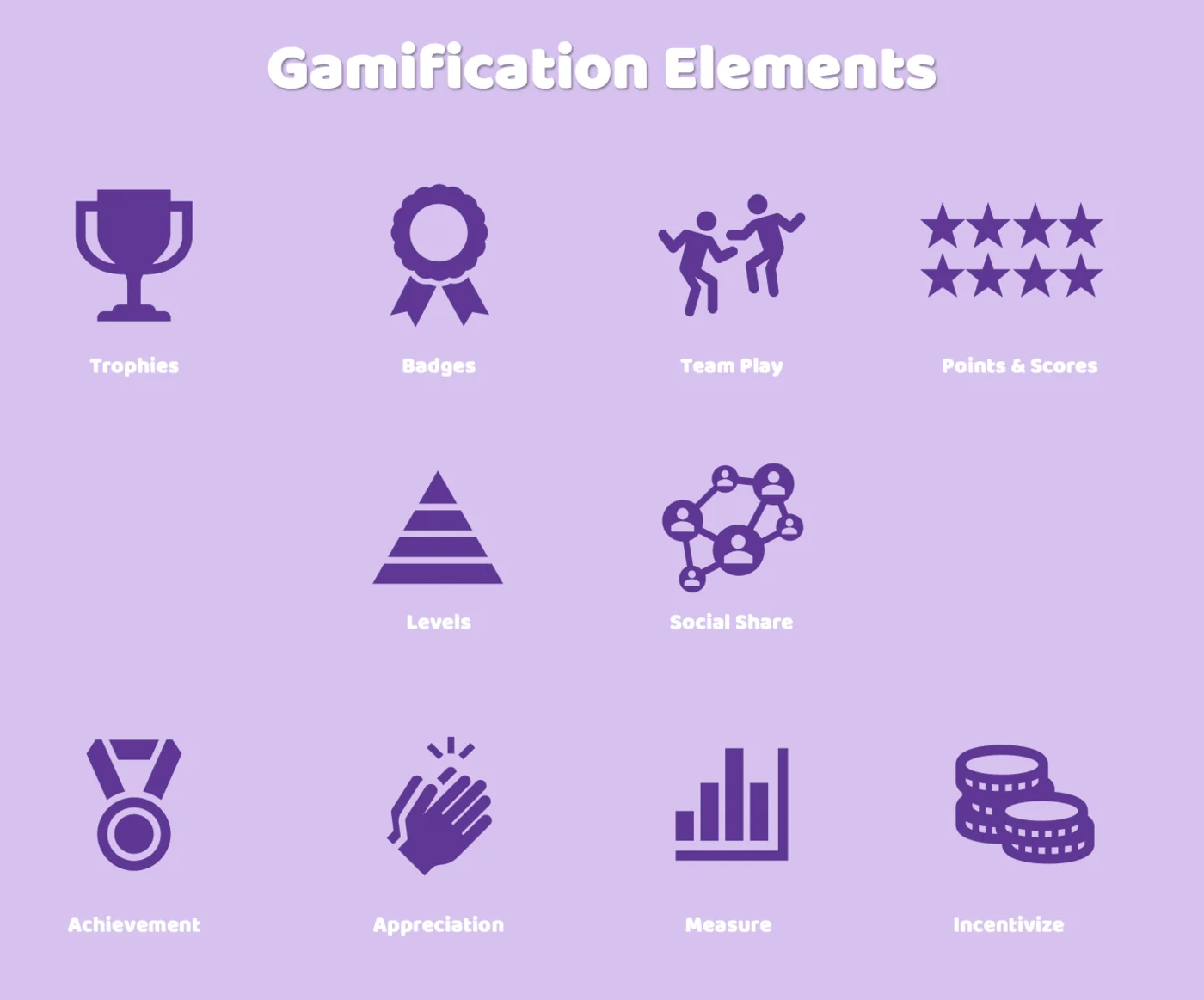
Popular techniques and elements
- Achievement badges, points and levels
- Incentives, both intrinsic and extrinsic
- Social sharing and tournaments
- Progress bars and performance graphs
- Virtual currency and leaderboards
- Meaningful stories and avatars
- Teammates and friends
- Motivating notifications and activity tracking
Start with one mechanic and one metric. Pick the single behaviour whose improvement would most obviously move the business, attach one mechanic to it, and measure for a month. A narrow win you can prove is worth far more than a full gamification layer nobody can evaluate.
Where gamification goes wrong
The failure modes are consistent enough to be worth naming, because almost every disappointing implementation is one of these four.
Rewarding the measurable instead of the valuable
Points attach easily to actions that are simple to count — logins, clicks, tickets closed — and those are rarely the actions that matter. A support team scored on tickets closed will close tickets. Whether the customer’s problem was solved is a different measurement, and if you are not making it, the mechanic will quietly optimise against you.
Leaderboards in the wrong culture
A public ranking is powerful in a sales floor where competition is already the norm. Drop the same leaderboard into a collaborative team and you get the opposite of what you wanted: people stop helping each other, because helping is unranked. Where the culture is collaborative, team-level goals and shared progress bars do the job that individual leaderboards do elsewhere.
Extrinsic rewards crowding out intrinsic motivation
This is the best-documented risk in the underlying psychology. When people already find work meaningful, attaching a small external reward to it can reduce their motivation rather than increase it — the reward reframes the activity as something you do for payment. The practical guidance is to use extrinsic rewards for tasks people genuinely find tedious, such as expense reporting or compliance training, and to use progress, mastery and recognition for work people already care about.
Novelty mistaken for engagement
Participation almost always spikes on launch. That spike tells you the feature is new, not that it works. The number worth watching is engagement in weeks six through twelve, once the novelty has worn off and only the people who find genuine value are still participating. Plan the measurement window accordingly, and resist declaring victory in week one.
Measuring whether it worked
Instrument before you launch, not after. At minimum you want a baseline for the target behaviour over a period long enough to show its natural variation, a control group or a staged rollout so you can attribute the change, and the target metric tracked alongside at least one counter-metric that would reveal gaming of the system.
That last one is what teams skip and later regret. If you are rewarding ticket volume, track customer satisfaction beside it. If you are rewarding course completion, track a knowledge check some weeks later. The counter-metric is the difference between knowing the programme worked and merely knowing that the numbers you chose to watch went up.
Boolean Solutions experience with gamification
We have designed and built gamification into existing SaaS applications, and delivered the leaderboards and dashboards that make tracking and monitoring those activities possible in the first place. In our experience the hard part is almost never the mechanic; it is agreeing on which behaviour is worth rewarding, and instrumenting it properly before anything is built on top.
Contact us to see the work we have done and to ask for a working prototype for your organisation.
Further reading
- Gamify — Brian Burke of Gartner, the best single book for organisations considering this
- Gamification trends — Finances Online
- The Art of Game Design — Jesse Schell, on the mechanics themselves
- SaaS gamification — HubSpot on whether it fits a SaaS product

Udit Mittal
Founder at Boolean Solutions. Twenty years of building and rescuing web, mobile and AI products for SaaS companies and startups — and writing down what actually worked.
Get in touch